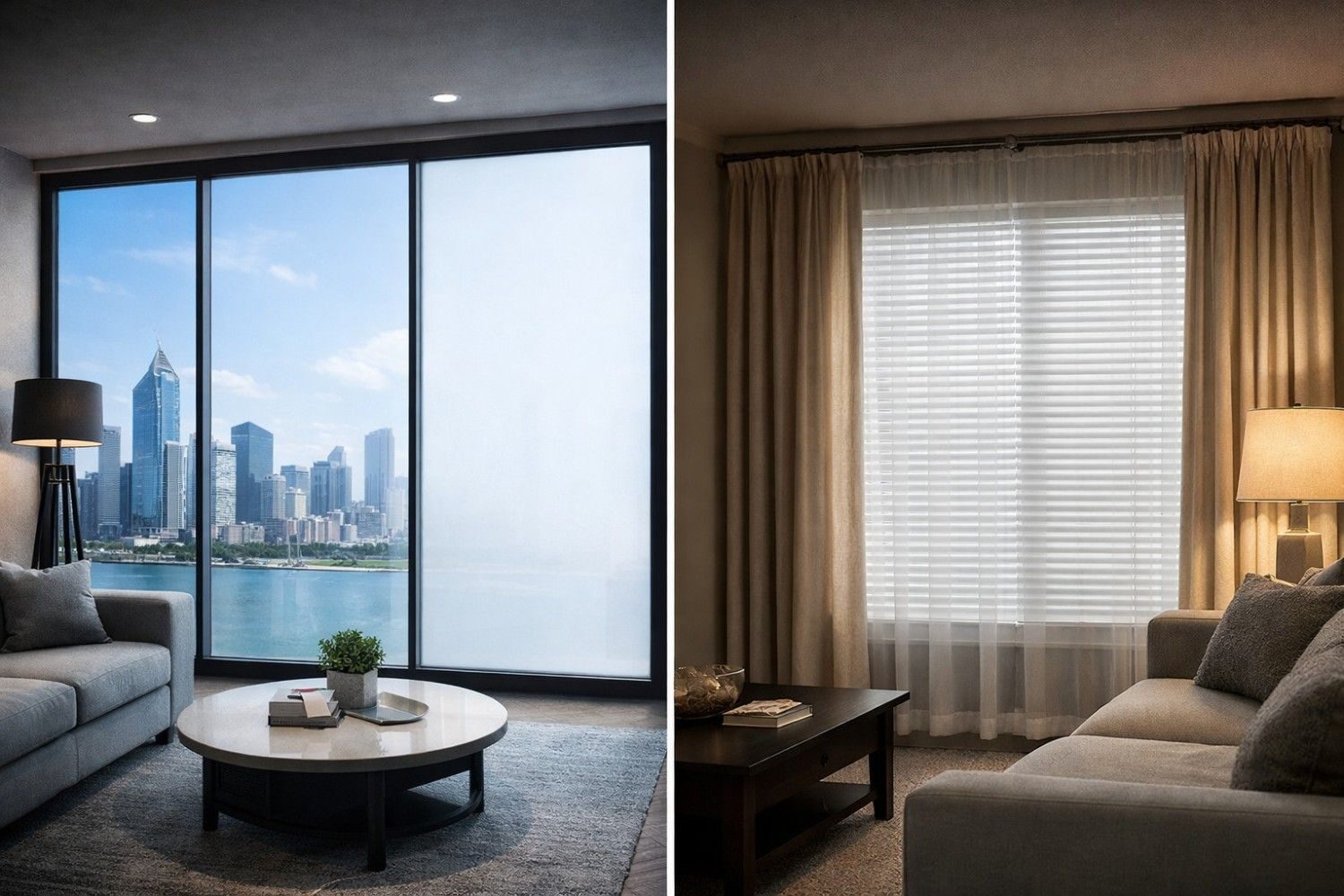
Smart Film vs Traditional Window Treatments
When evaluating Smart Film vs Traditional Window Treatments, conversations often begin with design preferences — clean glass versus layered fabrics, minimalism versus softness.
However, buyers in Dubai quickly move beyond aesthetics. Cost, durability, privacy performance, and long-term practicality ultimately drive the decision.
Smart film enhances certain spaces exceptionally well. Traditional window systems remain highly effective in others. The correct choice depends on application and performance expectations.
This guide explains how both systems perform in real-world UAE conditions so you can make an informed decision.
What Is Smart Film?
Smart film is based on PDLC (Polymer Dispersed Liquid Crystal) technology.
Liquid crystals are embedded within a thin film applied to glass.
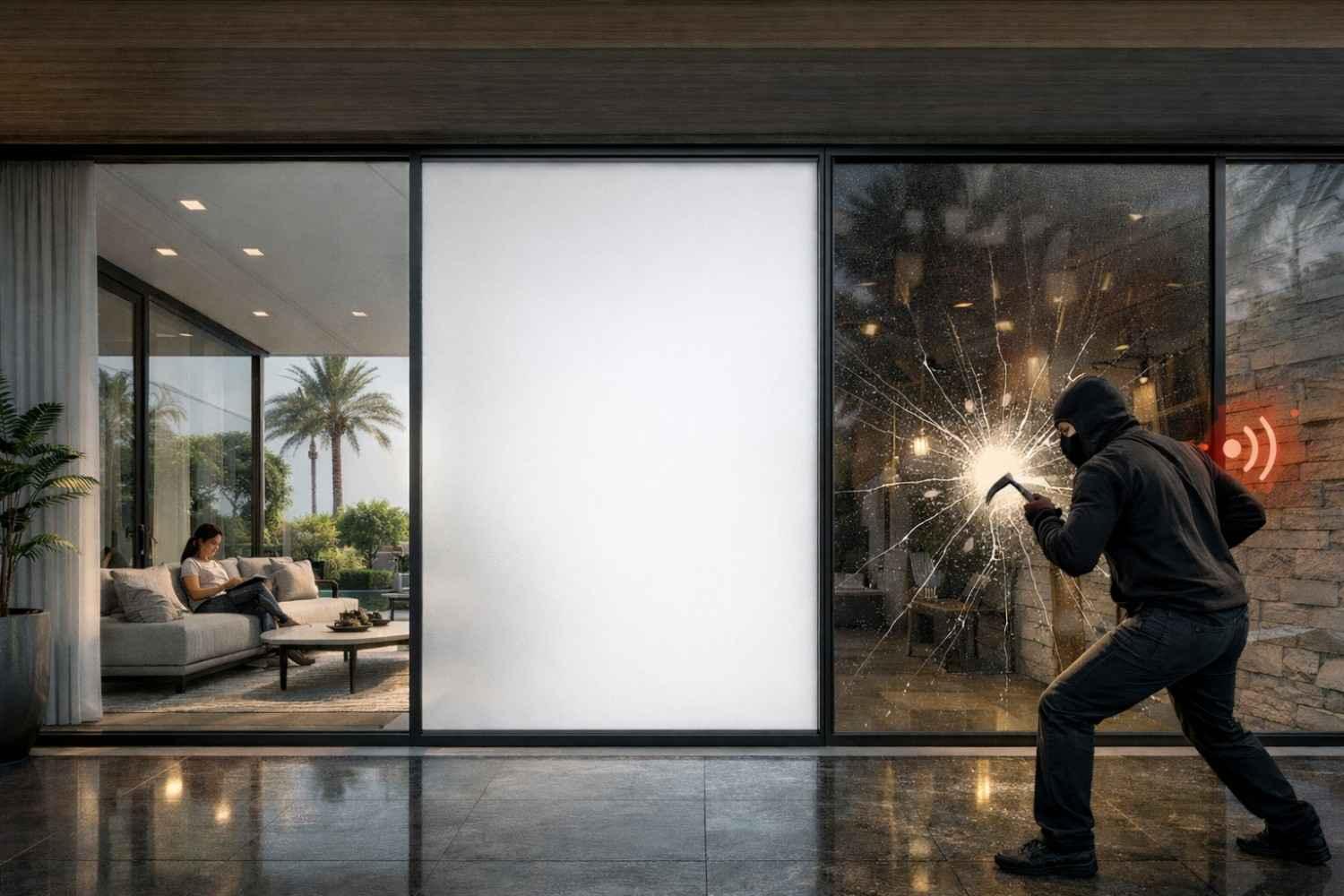
- When power is ON → crystals align → glass becomes transparent
- When power is OFF → crystals scatter light → surface turns frosted
Electricity is required to maintain transparency. Without power, the film remains opaque.
Smart film is typically applied to existing glass, making it suitable for retrofit projects. Laminated switchable glass, by contrast, integrates the smart layer between glass panels during manufacturing and is more common in new construction.
Understanding this distinction is essential before comparing it to blinds or curtains.
What Are Traditional Window Treatments?
Traditional window treatments include:
- Curtains
- Blackout curtains
- Roller blinds
- Venetian blinds
- Roman shades
- Drapery systems
They provide privacy by physically blocking visibility and can range from light filtering to full blackout.
These systems are mechanical and do not require electricity unless motorized. Installation is straightforward and widely accessible.
Unlike smart film, blackout systems can completely block light.
Performance Comparison
Privacy Control
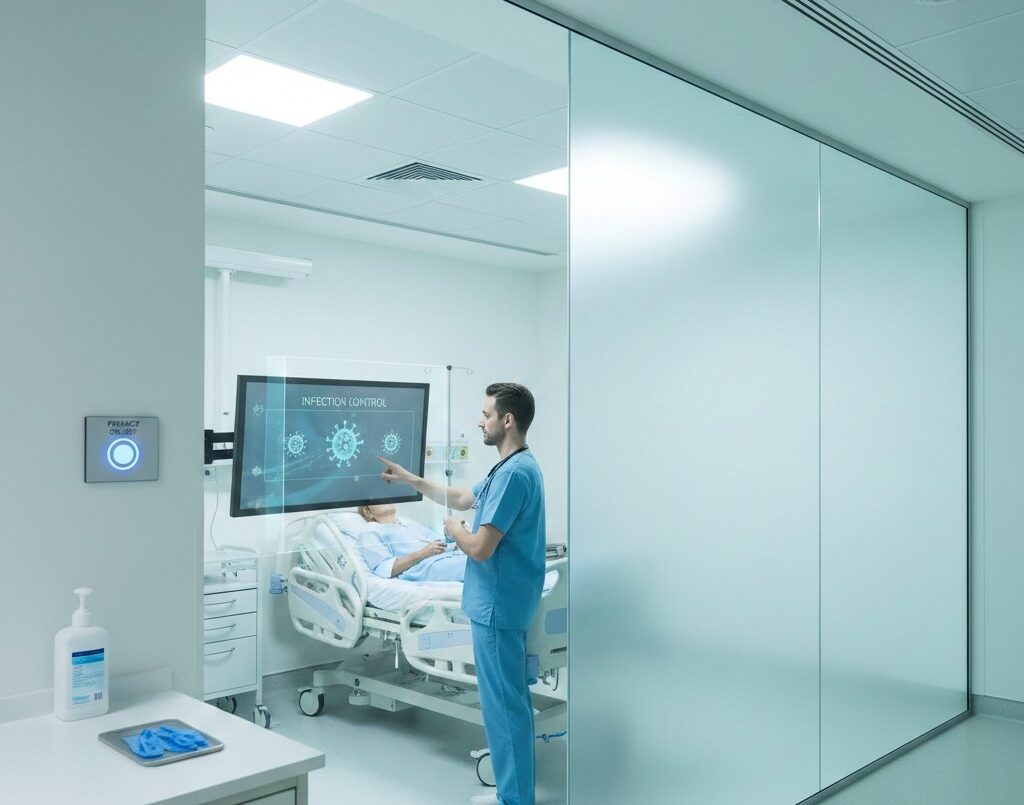
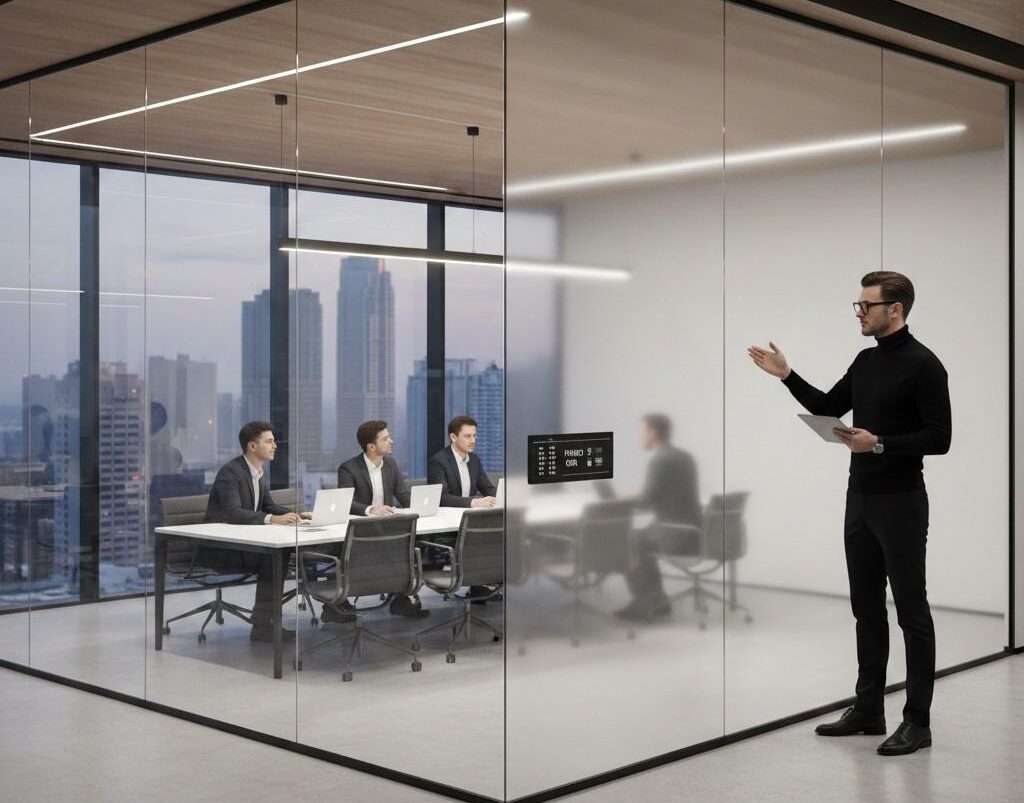
Smart film transitions from clear to frosted instantly, making it effective for conference rooms, healthcare spaces, and bathroom partitions.
However, frosted glass may still reveal faint shadows at close range.
Curtains and blinds create a full physical barrier when closed, ensuring complete visual blockage.
For commercial environments requiring fast privacy adjustments, electronic switching can be advantageous.
Light Control & Blackout Capability
Smart film diffuses light but does not create darkness.
Bedrooms, media rooms, and hospitality suites that require total blackout rely on traditional systems.
If complete light elimination is necessary, curtains or blinds remain the practical solution.
View Clarity & Optical Quality
High-quality smart film maintains good transparency, though minor haze or subtle distortion may appear on large panes.
In villas with panoramic views, even slight optical changes can influence decisions.
Standard glass with curtains preserves full visual sharpness when open.
Smart film is a great retrofit option, especially in Dubai, Abu Dhabi, Qatar, and Saudi Arabia where replacing fixed glass is costly.
Energy & Heat Performance in Dubai
Dubai’s strong solar exposure impacts glazing performance.
Smart film is not a solar control solution. In opaque mode, it diffuses light but does not significantly reduce heat transfer.
Curtains and blinds provide interior shading and glare reduction but do not alter the base glass insulation properties.
Energy efficiency primarily depends on the glazing specification itself. Neither system replaces proper solar control glass in high-heat environments.
Durability & Longevity
Traditional window systems are mechanically simple. Maintenance usually involves fabric replacement or minor hardware adjustments.
Smart film performance depends heavily on installation quality and electrical stability. Potential risks include surface scratching, creasing during installation, or electrical component failure.
In commercial settings, maintenance planning should be considered during specification.
Installation Complexity
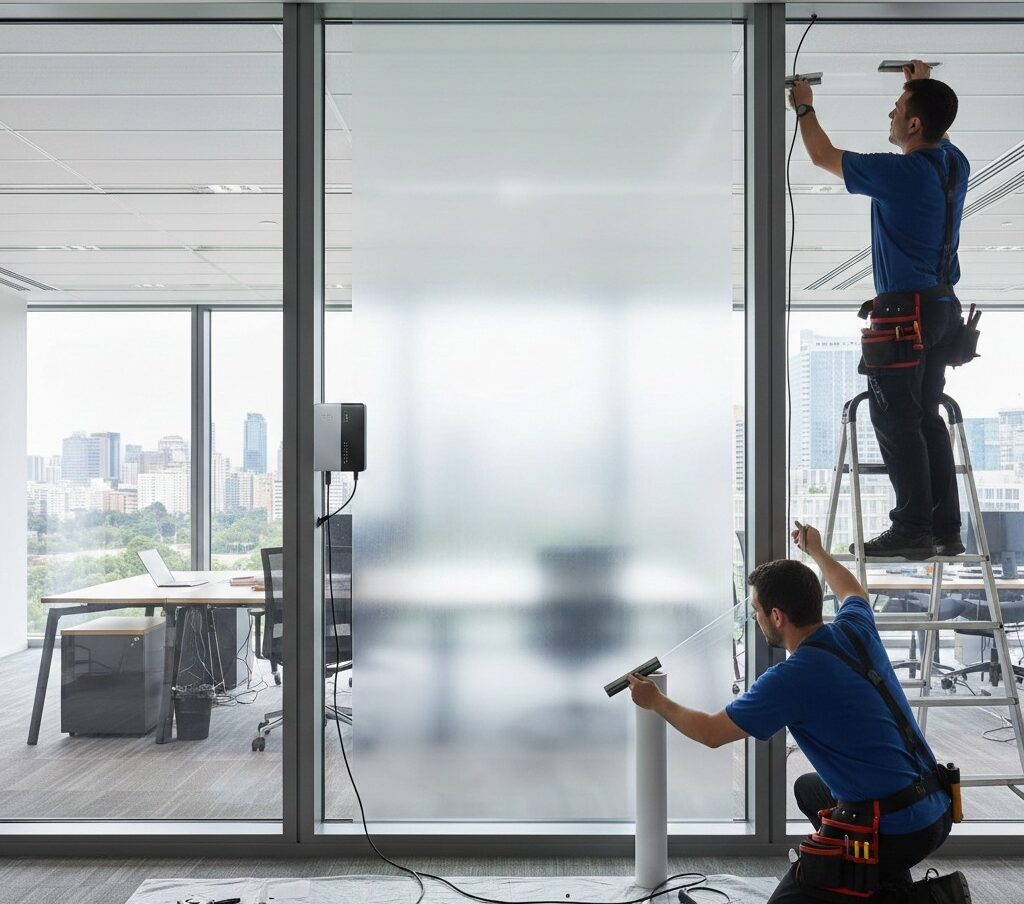
Smart film installation requires electrical coordination, transformer placement, and careful surface preparation.
Retrofitting older properties may require concealed wiring solutions.
Traditional window treatments require only mounting brackets and minimal structural impact, making themf faster to install.
Maintenance Requirements
Smart film relies on stable electrical components and switching systems.
Traditional treatments require routine cleaning and occasional hardware servicing.
Electrical systems introduce additional coordination for facility management.
Summary Comparison
| Criteria | Smart Film | Traditional Window Treatments |
|---|---|---|
| Privacy Speed | Instant electronic switching | Manual or motorized |
| Blackout | No | Yes |
| View Clarity | Slight haze possible | Full clarity |
| Installation | Electrical coordination required | Simple mounting |
| Maintenance | Electrical oversight | Mechanical servicing |
| Upfront Cost | Higher | Lower |
| Ideal For | Bathrooms, offices | Bedrooms, budget projects |
Cost Breakdown
Upfront Material Cost
Smart film carries a higher material cost compared to curtains or blinds. Pricing depends on glass size, electrical configuration, and project scale.
Traditional treatments offer a broader price range and are generally more accessible.
Installation & Infrastructure
Electrical wiring and transformer systems increase overall costs for smart film, particularly in villas with extensive glazing.
Traditional systems involve minimal infrastructure.
Scaling for Larger Properties
Covering large façades or multiple rooms significantly increases smart film costs.
Many Dubai homeowners choose selective installation — such as bathrooms or interior partitions — rather than full-home application.
Maintenance & Replacement
Replacing damaged smart film may require electrical disconnection and reapplication.
Curtains and blinds are easier to replace individually.
Long-term service access should be considered in ownership planning.

FAQs
It depends on application. Smart film offers instant privacy; blinds provide blackout and lower cost.
No. It diffuses light but does not eliminate it.
Higher upfront cost, electrical dependency, installation complexity, and possible optical haze.
Often suitable for bathrooms or feature areas. Full façade application requires careful budget evaluation.
With proper installation and stable electrical supply, systems can operate reliably for years. Longevity depends on usage and environmental conditions.
Best Use Cases
- Bathrooms → Smart film
- Bedrooms → Blackout blinds
- Conference rooms → Smart film
- Scenic living areas → Traditional curtains
- Budget renovations → Traditional window treatments
- Minimalist interiors → Smart film
Choosing the Right Solution
In the Smart Film vs Traditional Window Treatments comparison, neither system is universally superior.
Smart film delivers integrated privacy and clean design aesthetics. Traditional systems provide dependable blackout performance and predictable costs.
The right choice depends on space function, glazing specifications, and long-term ownership planning within Dubai’s climate.
Selective integration often achieves the most balanced result.
A site-specific technical evaluation ensures that privacy performance, electrical feasibility, and budget expectations align with your property’s needs.